In the mountains, everyone is a friend.
There are stories shared around a bonfire, at a breakfast table, at the base camp, inside tents; waves and smiles of encouragement en route the trails, emails exchanged; photos shared and a sense of camaraderie you just won’t find anywhere. The beaches are too private, the resorts are too posh, the cities are too rude and the roads – too unruly. But the mountains bring two completely disparate sets of people and make you believe they are the long lost friends you were meant to meet. After more than a dozen treks, this belief holds truer than the strongest of my convictions.
Ala-Kul was no different.

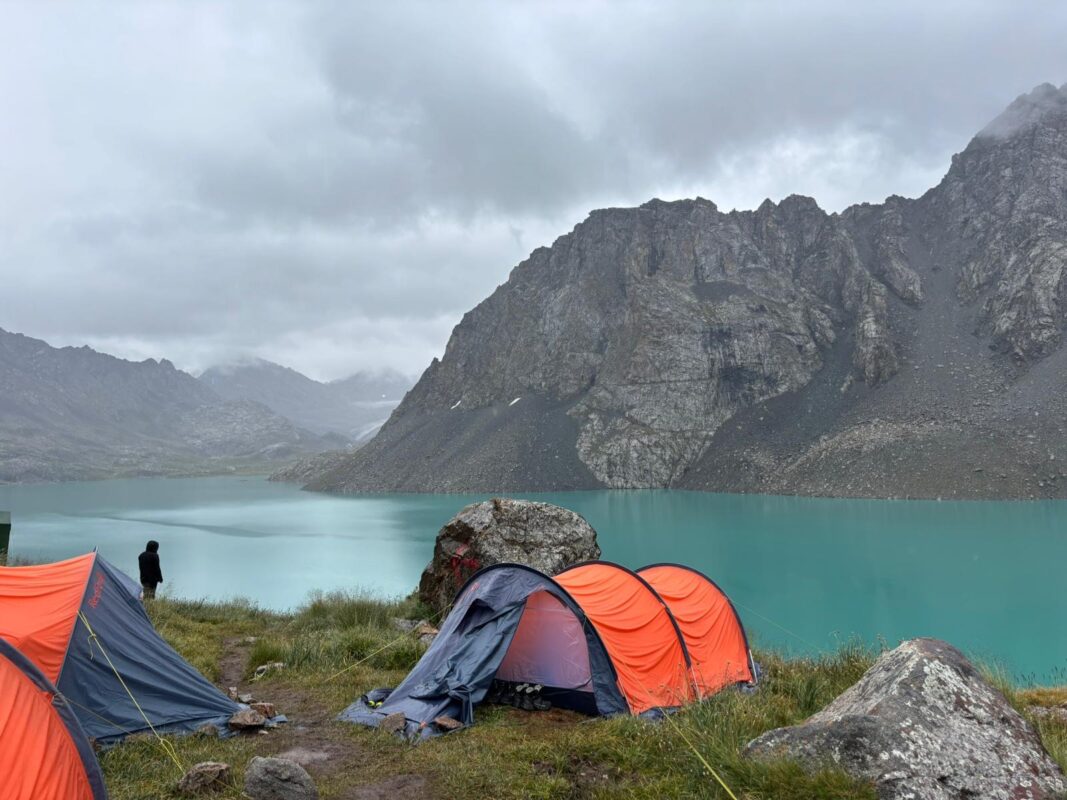
Seeing the turquoise blue lake is an experience of a lifetime. Nestled amidst 13,000-foot high peaks in the Tien Shan mountain range, the lake is like a jewel that was a secret held by nature until it was discovered by Russian traveller, Putimtsoff in 1811. Thirty years later, the famous German biologist Alexander von Schrenk travelled to the site and confirmed Putimtsoff’s observations.
Stories about Ala-Kul treks have been shared within trekking groups and nature lovers for many years now, and slowly these stories made their way to a mountain-lover like me, urging me to put it on my travel map. And so I packed my rucksack and made my way to Kyrgyzstan.

Some 400km from Bishkek, a town called Karakol, is a perfect base town for the trek. Having trekked in the Himalayas, in Hong Kong, New Zealand and in other places, a loaded rucksack is something I am used to carrying. So, when the offer came to carry my pack to Ala-Kul by porters, I resisted a little but eventually conceded. I felt guilty seeing them carry what seemed like a mountain perched on their backs. But it was the best decision I could take.

The porters in their slide-ons climbed effortlessly while I ambled my way up. The last 800 metres or so were the toughest. Many others climbed with a sprightly smile bucking me and all I could muster was a wince. Every muscle in my body said ‘no more’. But from the top, the breathtakingly turquoise blue glacial lake becomes visible. I overnighted by the lake in a tent and feasted on soupy noodles, a staple for all hikes (thanks to Nestle for inventing Maggi noodles).
The next day, after a kilometre of ascent to Altyn Arashan peak, it is a steep descent to the valley. This too proved to be hard. I hyperventilated when climbing down the mountain, slid and fell down more than 20 times in the slush, cursed more times in a day than I would in a year. At the river crossing, I held my guide’s hand like a child and repeatedly questioned if I had done the right thing daring to climb Ala-Kul.

But all hikes teach you that climbing a mountain is about conquering yourself, overcoming your fears, facing your trepidations and testing your endurance. It teaches you, you are stronger than you think and tougher than you are. Once you reach the base camp and have a mug of hot tea and meet other hikers who have had the very same experience as you, it all feels ok.

There was Jane from the UK, who despite her diminutive, unassuming self was an avid trekker. Having visited the Everest Base Camp, she told me Ala-Kul was harder, which gave me much comfort that my mountaineering struggles at Ala-Kul were not unfounded. Then there was a group of jolly Belgians who joked and laughed gregariously, sharing inquisitiveness about Kyrgyzstan and about fellow trekkers, talking about their travel experiences, learning a word or two in a foreign language and passing around goodies from home.

Nurgul, a Kyrgyz guide, does the arduous Ala-Kul trek 4 times a month. I wondered how could a polite and genteel woman like her do something so exhausting 4 times a month when I could only manage it once in my lifetime? “I just look at the nature, I don’t see the hardship,” she says. Aziz, a Dagestani, born in Russia who called Kyrgyzstan home does the Ala-Kul trek at least 8 times a month. He shared his tips on trekking and practiced his English with me while teaching me words in Russian.

The manager of a yurt camp – Vera, a Russian born in Bishkek but now living in Moscow talked about about her life during Soviet times while feeding us pancakes with cherry jam, porridge and melons. The owner of Green Yard Hotel, formerly a doctor, sent plates of cakes and home brewed tea to relieve us of our aches and pains after the trek. Fatima, the lady of the the Dungan household laid out a table full of traditional delicacies and made sure we were well fed. Virtually everyone I came across was hospitable, friendly and chatty to a fault.

The breakfast room in Karakol hotel was swarming with Italians, Germans, Swiss, Koreans and Singaporeans chatting about trek, adventures and misadventures, friendships and hardships, fears and fantasies, recommendations, traveller tips, and onward journeys. There was no language or gender barrier, nationality disconnect, capability contrast – just a common love for the mountains. I dare say, a beach holiday would never bring out such lively conversations and friendly exchanges. But mountains – they make everyone a friend.
And Ala Kul is where the world meets.
Other posts about Kyrgyzstan:
Oh my absolutely fantastic! What an incredible hike! Well done on achieving it! Xxx
It was a feat for sure, Anna. Thanks for the cheers from the other end. 🗻💪
Pingback: Alpine lakes of Kyrgyzstan – World Without Compass
Pingback: Kyrgyzstan – where Lenin and Manas live together – World Without Compass
Pingback: Alpine lakes of Kyrgyzstan – World Without Compass
These are really wonderful ideas in regarding blogging. You have touched some fastidious points here. Any way keep up wrinting.